
Astra Pilot AcademyAstra Pilot Academy
How it worksPlatformCurriculumStudyPractice testReviewsGuaranteeFAQFor teamsPricing
Log inOrganization login
Enroll now
Astra Pilot AcademyAstra Pilot Academy

Part 107 exam prep for the FAA knowledge test: study guides, a free practice test, and a course built on real FAA charts.

Product
  • Curriculum
  • Study guides
  • Free practice test
  • 12-question diagnostic
  • Pricing
  • Astra Pro
  • Guarantee
  • For Teams
Support
  • FAQ
  • Log in
  • Renew / recurrent
Legal
  • Terms of Service
  • Privacy Policy

© 2026 Astra Pilot Academy. All rights reserved.

Astra Pilot Academy is not affiliated with, endorsed by, or sponsored by the Federal Aviation Administration (FAA). Course-completion credential, not an FAA remote pilot certificate. FAA fees and passing score — confirm current details at faa.gov. FAA charts are public-domain U.S. Government works.

Home/Part 107 study guides/Load factor

Performance

Load factor

Load factor on the Part 107 test: what a G is, how bank angle multiplies it, and how to read FAA-CT-8080-2H Figure 2.

Practice, then train

Practice Load factor on the free Part 107 test

The free 20-question practice test follows the PSI topic weights, including chart figures, and scores you against the FAA's 70% mark. The individual course is $50 for the first 10 founding seats, then $149. If you meet the published conditions and fail your first FAA attempt, the pass guarantee is a course-price refund of what you paid us. It does not include PSI or FAA testing fees.

Take the free practice testSee pricing

Load factor is the load the aircraft structure is supporting divided by the aircraft's weight. The unit is G. In steady, straight flight the load factor is about 1: the wings or rotors support the weight of the aircraft and nothing more. The moment you bank in a level turn, or you pull abruptly, the structure supports more than the weight. That ratio is the load factor. It is not the payload mass, and it is not "how many batteries are installed."

Figure 2 is a table, not a vibe

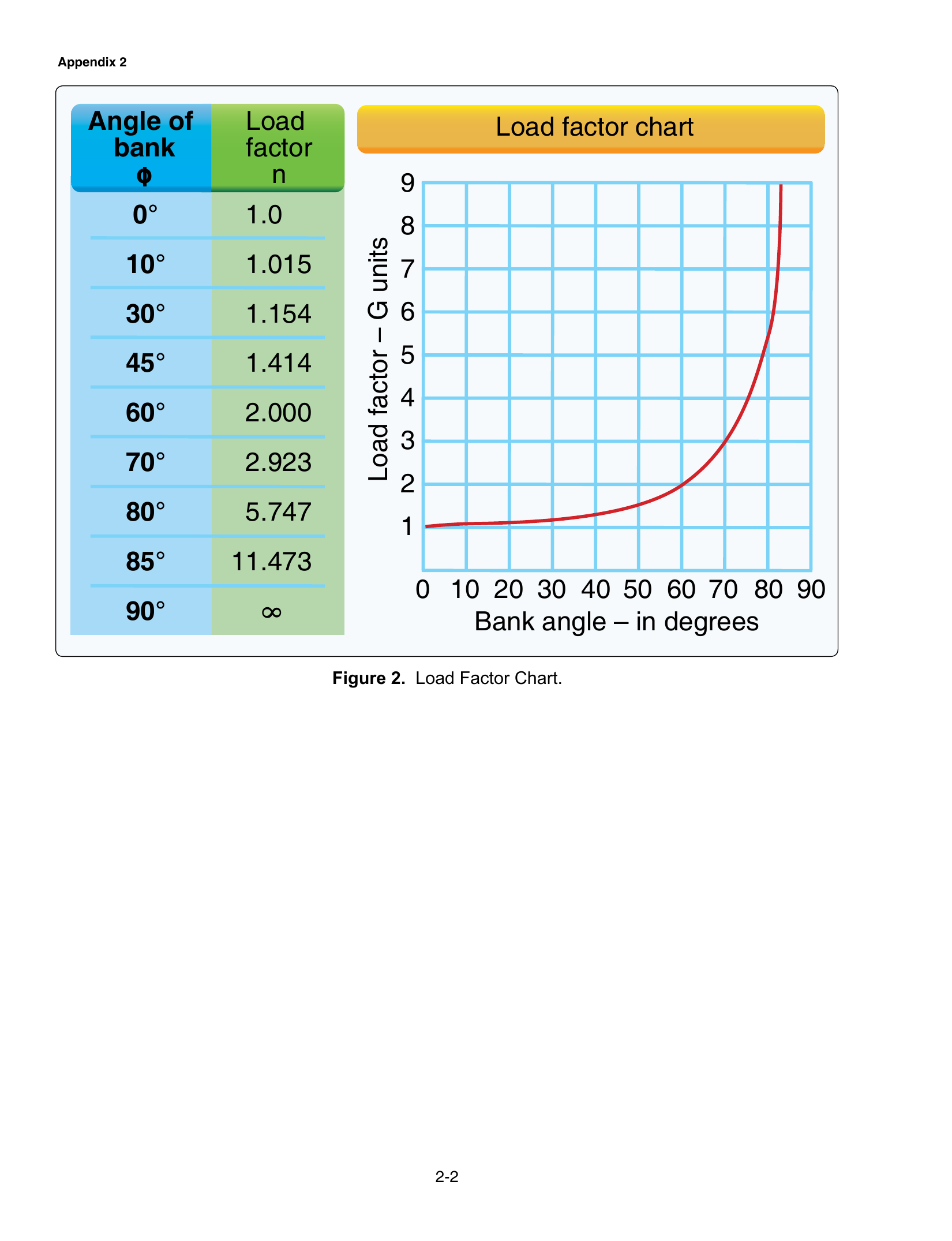
FAA-CT-8080-2H Figure 2 prints the load factor for a level bank. The course reads the table as 1.0 at 0 degrees, 1.015 at 10, 1.154 at 30, 1.414 at 45, 2.000 at 60, 2.923 at 70, 5.747 at 80, and 11.473 at 85. The underlying relationship for a level turn is 1 divided by the cosine of the bank angle. You do not need to derive it on test day if you can read the row you were given.

Figure 2 is the level-turn table. Do not invent a factor for a bank the figure does not list, and do not apply the 60-degree row to a shallower turn because the maneuver "felt steep."

A 60-degree bank is the clean memory point: load factor 2.000, so the structure supports twice the weight. A 45-degree bank is 1.414. A 30-degree bank is 1.154. The questions multiply. A 20-pound aircraft in a level 45-degree bank supports about 28 pounds, because 20 times 1.414 is about 28. A 40-pound aircraft in a level 30-degree bank supports about 46 pounds, because 40 times 1.154 is about 46. The wrong choices usually forget the bank and leave the load at the aircraft weight, or they apply the 60-degree factor of 2 to a shallower bank.

What changes the number in the air

Load factor on a small unmanned aircraft increases most when the pilot banks steeply or yanks the controls. A gentle cruise does not. Smooth inputs keep the load factor low. A small multirotor does not have a manned-aircraft spar, but the frame, the motors, and the propellers still have to produce the extra force. A steep bank or an abrupt stop can overstress the airframe or make the aircraft unstable, and it spends battery faster because the power demand went up.

Weight and load factor are related and still not the same limit. Adding payload increases the weight the 1 G hover must support, which hurts endurance. Banking multiplies whatever that weight already is. An out-of-limits center of gravity is a third problem: the aircraft can be under maximum weight and still be uncontrollable if the balance point is wrong. Read center of gravity as its own page. Do not "fix" a bad CG by banking.

Performance around the maneuver

The manufacturer's limits are limits. Maximum wind, maximum takeoff weight, and the temperature range are not targets. If the wind is gusting above the published maximum, the flight is a no-go even if you promise to keep the banks shallow. Cold weather cuts battery performance, so the same maneuver that was fine at 20 °C can sag at freezing. High density altitude, the hot high humid case on the density altitude page, means the rotors are already making less lift before you ask them for extra G.

Loading and performance is only about 2 percent of the scored UAG test under the PSI bulletin effective September 29, 2025. The items are still predictable: define load factor, read Figure 2, and multiply. Practice the three rows 30, 45, and 60 until the factors 1.154, 1.414, and 2.000 are automatic, then do one multiplication with a realistic weight so the "about 28 pounds" style of answer looks familiar.
Sources

  • Remote Pilot ACS (FAA-S-ACS-10B), loading and performance
  • Remote Pilot study guide (FAA-G-8082-22)
  • FAA-CT-8080-2H Figure 2, included with the testing supplement figures in this course

Astra Pilot Academy is not affiliated with the FAA. Rules and fees change. Confirm the current text before you fly or schedule a test.

Chart figures

These are public-domain FAA test-supplement figures already used in the course. Read the printed labels. The sample questions below use the same figures when they say to refer to one.

Load factor chart. FAA-CT-8080-2H Figure 2.
Load factor chart · FAA-CT-8080-2H Figure 2. FAA-CT-8080-2H Figure 2 (Load Factor Chart), supplement page 2-2, PDF page 36 of the official sport/recreational/private testing supplement. Rendered at 200 dpi. U.S. Government work — public domain.

Sample questions

Three items from the course question bank. Each has the same three choices the bank uses. Open the explanation to see the keyed answer. These are not new questions.

  1. Question 1

    (Refer to FAA-CT-8080-2H Figure 2.) Which load factor does the load factor chart list for a 60 degree bank?

    • A1.154
    • B1.414
    • C2.000
    Show explanation

    Answer C. 2.000

    Figure 2's table lists a load factor of 2.000 at 60 degrees of bank, 1.414 at 45 degrees, and 1.154 at 30 degrees. In a level turn the load factor is 1 divided by the cosine of the bank angle. A 60 degree bank doubles the load the structure supports.

  2. Question 2

    (Refer to FAA-CT-8080-2H Figure 2.) A small unmanned aircraft weighs 20 pounds. About how much load must the structure support in a level 45 degree bank?

    • AAbout 20 pounds, because load factor stays at 1.0 in any bank
    • BAbout 28 pounds
    • CAbout 40 pounds
    Show explanation

    Answer B. About 28 pounds

    Figure 2 lists a load factor of 1.414 at 45 degrees of bank. 20 pounds times 1.414 is about 28 pounds. Straight-and-level flight is about 1.0, which would leave the load at 20 pounds. A load factor of 2.000, which the chart lists at 60 degrees, would be about 40 pounds.

  3. Question 3

    Load factor is best described as:

    • AThe ratio of the load supported by the structure to the aircraft's actual weight (in Gs)
    • BThe total payload weight in grams
    • CThe number of batteries installed
    Show explanation

    Answer A. The ratio of the load supported by the structure to the aircraft's actual weight (in Gs)

    Load factor = load ÷ weight (Gs).

FAQ

What is load factor?

Load factor is the ratio of the load the structure supports to the aircraft's actual weight. It is measured in Gs. In straight, unaccelerated flight it is about 1 G. It is not the payload weight in grams and it is not the number of batteries.

What load factor does Figure 2 list at 60 degrees of bank?

Figure 2 lists 2.000 at 60 degrees, 1.414 at 45 degrees, and 1.154 at 30 degrees. In a level turn the load factor is 1 divided by the cosine of the bank angle.

Why does a steep bank matter on a small drone?

A level turn increases the load the frame and motors must support. A 20-pound aircraft at the 1.414 load factor Figure 2 lists for 45 degrees must support about 28 pounds. Abrupt inputs and steep banks raise power demand and can overstress a small airframe. Smooth inputs keep the load factor lower.

Related study guides

  • Density altitude
  • Center of gravity and weight
  • The Part 107 400-foot rule
  • Cold weather and drone batteries
  • The four forces of flight

Practice, then train

Practice Load factor on the free Part 107 test

The free 20-question practice test follows the PSI topic weights, including chart figures, and scores you against the FAA's 70% mark. The individual course is $50 for the first 10 founding seats, then $149. If you meet the published conditions and fail your first FAA attempt, the pass guarantee is a course-price refund of what you paid us. It does not include PSI or FAA testing fees.

Take the free practice testSee pricing