
Astra Pilot AcademyAstra Pilot Academy
How it worksPlatformCurriculumStudyPractice testReviewsGuaranteeFAQFor teamsPricing
Log inOrganization login
Enroll now
Astra Pilot AcademyAstra Pilot Academy

Part 107 exam prep for the FAA knowledge test: study guides, a free practice test, and a course built on real FAA charts.

Product
  • Curriculum
  • Study guides
  • Free practice test
  • 12-question diagnostic
  • Pricing
  • Astra Pro
  • Guarantee
  • For Teams
Support
  • FAQ
  • Log in
  • Renew / recurrent
Legal
  • Terms of Service
  • Privacy Policy

© 2026 Astra Pilot Academy. All rights reserved.

Astra Pilot Academy is not affiliated with, endorsed by, or sponsored by the Federal Aviation Administration (FAA). Course-completion credential, not an FAA remote pilot certificate. FAA fees and passing score — confirm current details at faa.gov. FAA charts are public-domain U.S. Government works.

Home/Part 107 study guides/NOTAMs for Part 107

Airspace and charts

NOTAMs for Part 107

Why a Part 107 preflight includes NOTAMs, how TFRs fit under §107.47, and how to get a briefing from Flight Service.

Practice, then train

Practice NOTAMs for Part 107 on the free Part 107 test

The free 20-question practice test follows the PSI topic weights, including chart figures, and scores you against the FAA's 70% mark. The individual course is $50 for the first 10 founding seats, then $149. If you meet the published conditions and fail your first FAA attempt, the pass guarantee is a course-price refund of what you paid us. It does not include PSI or FAA testing fees.

Take the free practice testSee pricing

A sectional is a standing picture. A NOTAM is how that picture changes today. Part 107 points at both. Section 107.49 says the remote pilot in command, before flight, assesses the operating environment, including local airspace and any flight restrictions. Section 107.47 says the remote pilot must comply with §§91.137 through 91.145 and §99.7 of 14 CFR. Those sections are the temporary flight restriction and national-security airspace rules that are published by NOTAM.

What you are looking for

Temporary flight restrictions cover hazards, disasters, VIP movement, stadiums and major sporting events, and security-sensitive airspace. The chart does not update when a wildfire TFR goes up this morning. The NOTAM does. Stadium restrictions and §99.7 security airspace are the reason "I checked the sectional last month" is not a preflight.

Section 107.47 incorporates the temporary-flight-restriction rules in §§91.137 through 91.145 and the security airspace in §99.7. Those notices can appear the morning of the flight. A stadium event, a disaster area, or a security restriction does not have to be printed on the sectional you studied last month.

The ACS specifically expects you to know that an established NOTAM briefing is available from Flight Service. Call 1-800-WX-BRIEF or use 1800wxbrief.com, and ask for the NOTAMs relevant to the operation. A PDF of a sectional saved on a tablet is not that briefing. Assuming no NOTAM applies to small unmanned aircraft is not that briefing either.

The course is careful about one sentence students over-read. A NOTAM is not automatically required to exist for every UAS operation unless the authorization or waiver says the operation itself must be NOTAMed. You can fly a legal Part 107 flight in Class G with no NOTAM filed about you. You still look up the NOTAMs that other people have filed, because one of them may restrict the airspace you wanted.

Chart notes that point at NOTAMs

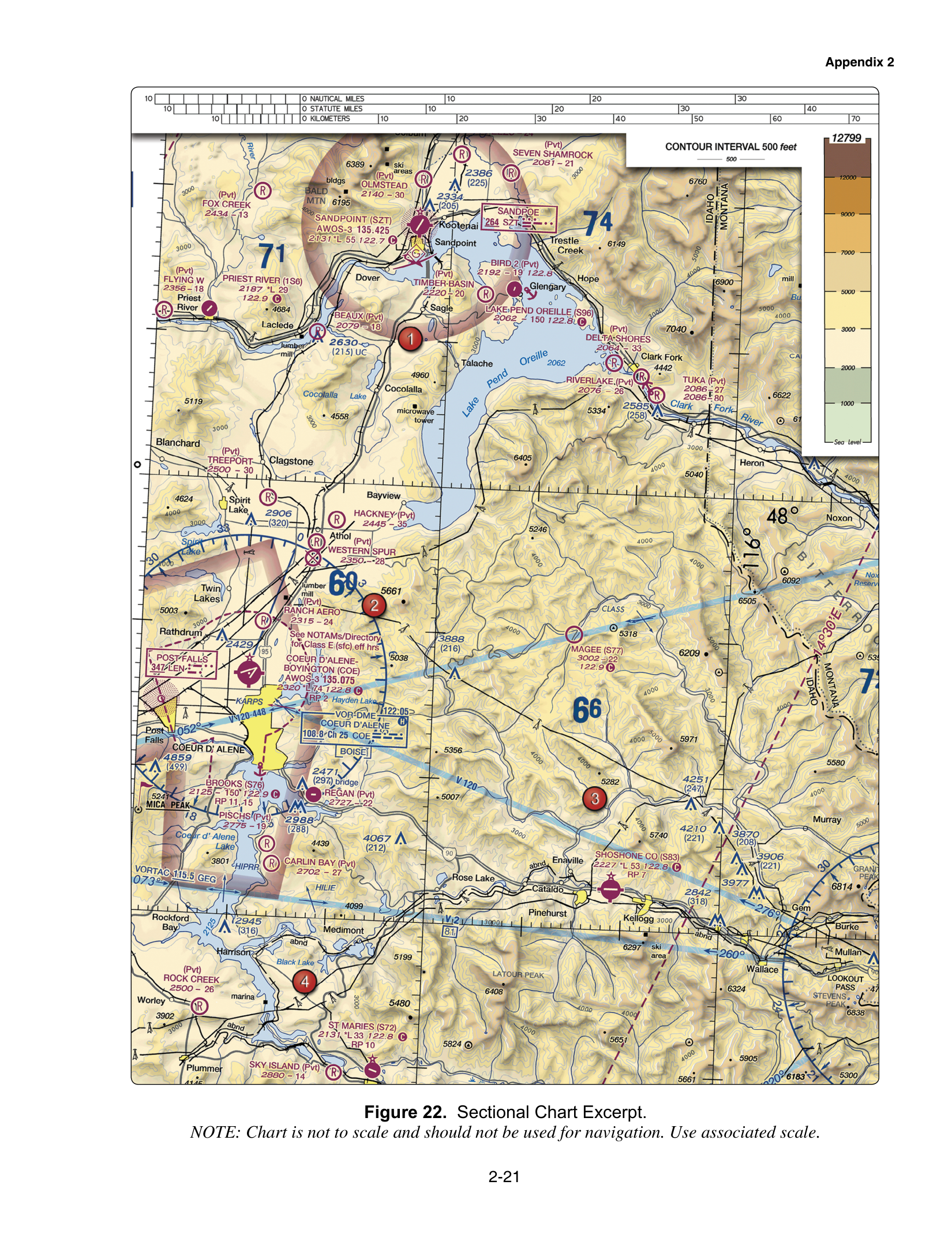
Some sectionals tell you the chart is incomplete on purpose. FAA-CT-8080-2H Figure 22, the Coeur d'Alene excerpt, prints a note to see NOTAMs and the directory for the effective hours of Class E at the surface. The directory is the Chart Supplement. While that surface Class E is in effect, you need prior ATC authorization under §107.41. When it is not in effect, the surface is Class G, up to the overlying Class E floor. Near Coeur d'Alene that floor is the 700-foot magenta vignette. The note is not itself a LAANC approval. It is an instruction to go check.

Part-time Class D and part-time towers work the same way. The star on the airport symbol means "look up the hours," not "the tower is closed."

Special-use airspace and TFRs are different layers

A restricted area has published times and a controlling agency. A TFR can cover a town that has no restricted area at all. Clearing one does not clear the other. Military Operations Areas and restricted areas are charted special-use airspace, covered on the MOA and restricted area page. A TFR is temporary even when the reason, such as a major sporting event, happens on a schedule. Read the NOTAM text for the radius, the altitude, and the times. The chart, the Chart Users' Guide notes, depicts only certain security-related TFRs. The rest exist only in the notice.

Where this sits in the preflight

Weather, NOTAMs, and the aircraft manual are separate resources. A clear TAF does not cancel a TFR. A LAANC approval does not cancel one either. If you are the remote pilot, you are the person §107.47 applies to. Delegating the tap on a consumer map, without knowing what source it used and how fresh it is, does not move the duty. Use an official briefing, then fly inside what it allows.
Sources

  • 14 CFR §107.47 — flight restrictions in NOTAMs
  • 14 CFR §107.49 — preflight, including airspace and flight restrictions
  • 1800wxbrief.com
  • Remote Pilot ACS (FAA-S-ACS-10B)

Astra Pilot Academy is not affiliated with the FAA. Rules and fees change. Confirm the current text before you fly or schedule a test.

Chart figures

These are public-domain FAA test-supplement figures already used in the course. Read the printed labels. The sample questions below use the same figures when they say to refer to one.

Mountain airports & CTAF (Coeur d'Alene, ID). FAA-CT-8080-2H Figure 22.
Mountain airports & CTAF (Coeur d'Alene, ID) · FAA-CT-8080-2H Figure 22. FAA-CT-8080-2H Figure 22 (Coeur d'Alene, Idaho), supplement page 2-21. U.S. Government work — public domain.

Sample questions

Three items from the course question bank. Each has the same three choices the bank uses. Open the explanation to see the keyed answer. These are not new questions.

  1. Question 1

    Before every flight, a remote pilot should check NOTAMs primarily to identify:

    • AWhether the aircraft registration is still within its 3-year term
    • BTemporary flight restrictions and other temporary hazards or closures
    • CThe 24-hour temperature trend in the terminal forecast
    Show explanation

    Answer B. Temporary flight restrictions and other temporary hazards or closures

    NOTAMs publish temporary flight restrictions, closures, and other time-critical hazards. Registration status and a temperature trend are checked elsewhere. A preflight briefing from Flight Service is one way to get current NOTAMs.

  2. Question 2

    Before a flight, you need current NOTAM information and a briefing. Which action aligns with the ACS?

    • AContact Flight Service at 1-800-WX-BRIEF or use 1800wxbrief.com
    • BUse only a saved sectional chart
    • CAssume no NOTAM applies to small UAS
    Show explanation

    Answer A. Contact Flight Service at 1-800-WX-BRIEF or use 1800wxbrief.com

    The ACS specifically includes how to obtain an established NOTAM through Flight Service. Use current official briefing sources and check applicable restrictions; a NOTAM is not universally required for every UAS flight unless a waiver/authorization says so.

  3. Question 3

    (Refer to FAA-CT-8080-2H Figure 22.) A note beside Coeur d'Alene says to see NOTAMs and the directory for the effective hours of Class E at the surface. What should a remote pilot do with that note?

    • ACheck the Chart Supplement and NOTAMs for the hours. Surface Class E needs ATC authorization while it is in effect; when it is not in effect the surface area is Class G
    • BTreat the surface area as Class E all day, because a part-time note removes the need to check hours
    • CThe note authorizes flight in surface Class E during the published hours without ATC authorization
    Show explanation

    Answer A. Check the Chart Supplement and NOTAMs for the hours. Surface Class E needs ATC authorization while it is in effect; when it is not in effect the surface area is Class G

    The figure points part-time surface Class E hours to NOTAMs and the directory, which is the Chart Supplement. While that surface Class E is in effect, §107.41 requires prior ATC authorization. When it is not in effect, the surface area is Class G. Near Coeur d'Alene that Class G extends only up to the 700-foot AGL floor of the overlying Class E, the magenta vignette on this chart. The note is not itself an authorization.

FAQ

Do I have to check NOTAMs before every Part 107 flight?

Section 107.49 requires the remote pilot to assess local airspace and any flight restrictions before flight. Section 107.47 requires compliance with the temporary flight restrictions in §§91.137 through 91.145 and with §99.7. A NOTAM is not automatically published for every small-UAS flight unless an authorization or waiver says so. You still check, because that is how you learn the restrictions that do exist.

How does the ACS expect you to get a NOTAM briefing?

Flight Service: 1-800-WX-BRIEF or 1800wxbrief.com. A saved sectional does not include today's TFR. Assuming small UAS are exempt from NOTAMs is not correct.

What do I do with a chart note that says see NOTAMs for surface Class E hours?

Check the Chart Supplement and NOTAMs for the effective hours. While that surface Class E is in effect, §107.41 requires prior ATC authorization. When it is not in effect, the surface area is Class G. The note itself is not an authorization.

Related study guides

  • MOAs and restricted areas
  • What LAANC authorizes
  • How to read a TAF
  • Part 107 airspace classes
  • Sectional chart symbols for Part 107

Practice, then train

Practice NOTAMs for Part 107 on the free Part 107 test

The free 20-question practice test follows the PSI topic weights, including chart figures, and scores you against the FAA's 70% mark. The individual course is $50 for the first 10 founding seats, then $149. If you meet the published conditions and fail your first FAA attempt, the pass guarantee is a course-price refund of what you paid us. It does not include PSI or FAA testing fees.

Take the free practice testSee pricing