
Astra Pilot AcademyAstra Pilot Academy
How it worksPlatformCurriculumStudyPractice testReviewsGuaranteeFAQFor teamsPricing
Log inOrganization login
Enroll now
Astra Pilot AcademyAstra Pilot Academy

Part 107 exam prep for the FAA knowledge test: study guides, a free practice test, and a course built on real FAA charts.

Product
  • Curriculum
  • Study guides
  • Free practice test
  • 12-question diagnostic
  • Pricing
  • Astra Pro
  • Guarantee
  • For Teams
Support
  • FAQ
  • Log in
  • Renew / recurrent
Legal
  • Terms of Service
  • Privacy Policy

© 2026 Astra Pilot Academy. All rights reserved.

Astra Pilot Academy is not affiliated with, endorsed by, or sponsored by the Federal Aviation Administration (FAA). Course-completion credential, not an FAA remote pilot certificate. FAA fees and passing score — confirm current details at faa.gov. FAA charts are public-domain U.S. Government works.

Home/Part 107 study guides/Class D airspace for drone pilots

Airspace and charts

Class D airspace for drone pilots

Class D is a dashed blue line, and it needs prior ATC authorization. A boxed ceiling like [-30] is the surface up to but not including 3,000 feet MSL.

Practice, then train

Practice Class D airspace for drone pilots on the free Part 107 test

The free 20-question practice test follows the PSI topic weights, including chart figures, and scores you against the FAA's 70% mark. The individual course is $50 for the first 10 founding seats, then $149. If you meet the published conditions and fail your first FAA attempt, the pass guarantee is a course-price refund of what you paid us. It does not include PSI or FAA testing fees.

Take the free practice testSee pricing

Class D airspace is shown with a dashed blue line, and Part 107 operations inside it need prior ATC authorization under §107.41. A boxed ceiling such as [-30] means the Class D runs from the surface up to, but not including, 3,000 feet MSL. The surface is the floor. The number is MSL with the last two zeros omitted, and the minus sign is what keeps the aircraft out of the altitude printed on the box.

Dashed blue, then the authorization

Two chart items ask for the same symbol. Class D is a dashed blue line, not a faded blue edge and not a solid magenta line. A faded blue edge is a Class E floor, generally where that floor meets Class G. Solid magenta is Class C. Dashed magenta is Class E at the surface, which is a different authorization case on the Class E surface page. Line color and dash versus fade are laid out on the magenta and blue page.

The second item adds the legal consequence. Prior ATC authorization is required for Part 107 operations in Class D. Section 107.41 names Class D alongside Class B, Class C, and Class E airport surface areas. A radio call to the tower is not itself the authorization the regulation requires, and staying under 400 feet AGL does not remove the airspace from the list. The paths are LAANC, where a grid is published, or DroneZone where it is not. The approval caps you at the altitude it states. It does not waive the visibility, cloud, and speed limits in §107.51.

The Chart Users' Guide identifies Class D with a blue dashed line and shows ceilings in the form the Addison box uses. Read the box before you decide the cylinder is "about 2,500 feet" from memory. The printed ceiling is the one that counts.

What [-30] means at Addison

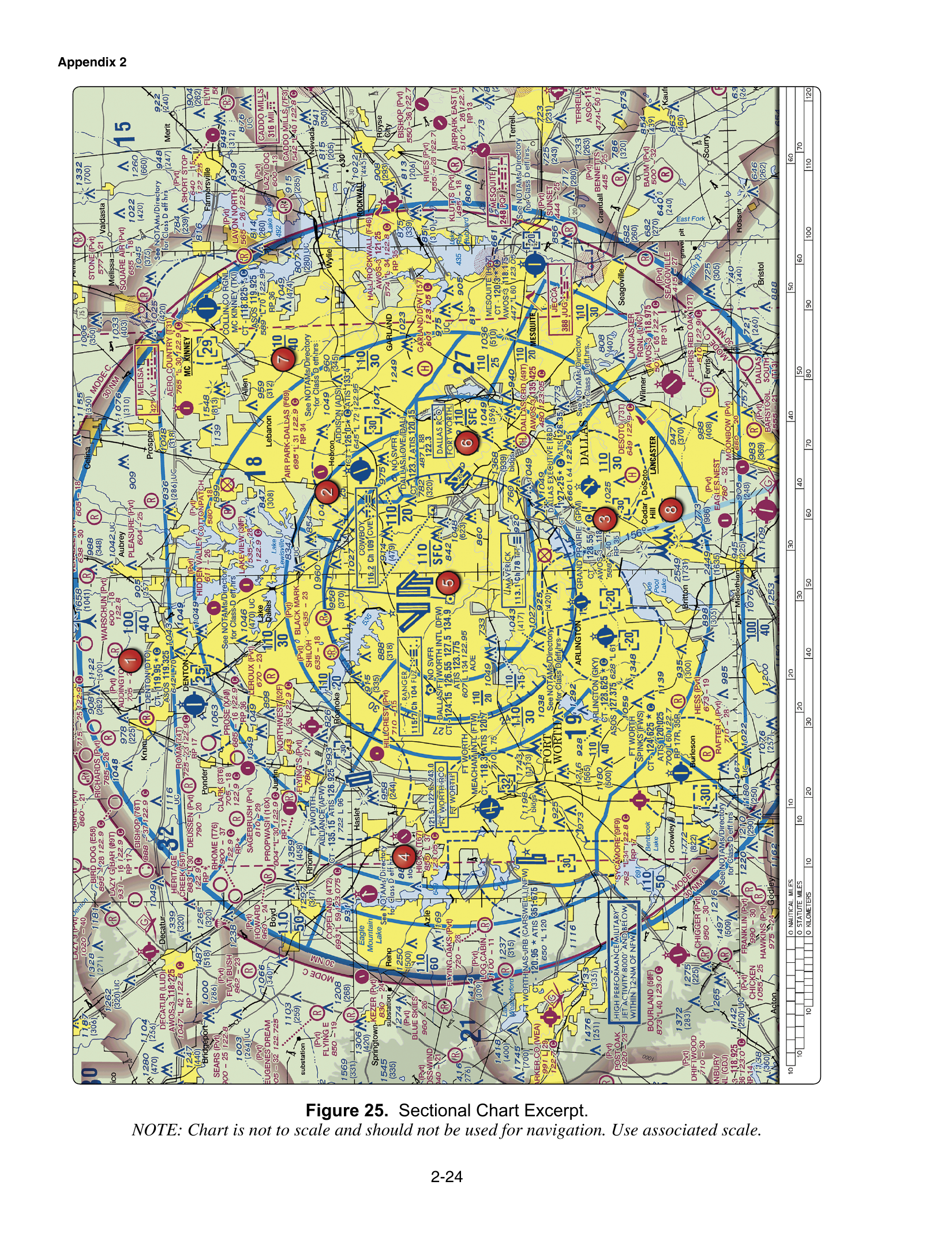
FAA-CT-8080-2H Figure 25 prints Addison's Class D ceiling in a box as [-30]. The figure check is the dashed blue ring and that boxed [-30]. A minus sign in front of a Class D ceiling means from the surface up to, but not including, the altitude. The printed figure drops two zeros, so [-30] is up to but not including 3,000 feet MSL.

The floor is the surface. The box is not a statement that Class D begins at 3,000 feet AGL and extends upward. That reading flips the cylinder upside down and changes MSL to AGL. The box is also not an airport elevation of 30 feet with an unlimited ceiling. Thirty is the ceiling figure with the zeros removed, and the minus is a vertical limit, not a field elevation.

"Up to but not including" matters at the top of the Class D, where the overlying airspace takes over at exactly 3,000 feet MSL. For a Part 107 flight the practical point is the bottom: the surface is inside the dashed blue line, so a roof inspection at 200 feet AGL is in this Class D while that ceiling is in effect. You need the authorization at drone height. You do not need to be near 3,000 feet MSL before §107.41 applies.

A job inside Addison's ring

Figure 25 is the Dallas–Fort Worth area chart this course uses for both the Class B core and Addison. For the Class D question you stay on Addison's dashed blue boundary and the boxed [-30]. The site is inside the dashes. You read the ceiling as surface to, but not including, 3,000 feet MSL. The planned altitude is 250 feet AGL, which is inside that block on a field that sits well below 3,000 feet MSL. You obtain prior ATC authorization before launch. If the LAANC grid for that cell is 100 feet, the flight is at or below 100 feet. The dashed blue line told you the airspace class. The box told you the top. The authorization told you the altitude you may actually use.

You do not reclassify the ring as Class C because the airport is busy, and you do not call a faded blue vignette on another part of the chart a Class D. The dash is the Class D mark.

The trap

The symbol trap offers a faded blue edge or a solid magenta line. Class D is dashed blue. The authorization item repeats the symbol and then keys prior ATC authorization, so a correct line style with a "radio only" rule is still wrong.

The ceiling trap is the boxed [-30] on Figure 25. Restore two zeros to get 3,000 feet MSL. Apply the minus sign as "from the surface up to but not including." Discard "begins at 3,000 feet AGL and extends upward," and discard "the airport elevation is 30 feet and the ceiling is unlimited."

Practice the dashed blue ring on the free practice test. The chart lessons in the course use Addison's box so the minus sign is read as a ceiling, with the surface as the floor.
Sources

  • 14 CFR §107.41 — operation in certain airspace
  • FAA Aeronautical Chart Users' Guide, edition effective 22 Jan 2026
  • Aeronautical Information Manual

Astra Pilot Academy is not affiliated with the FAA. Rules and fees change. Confirm the current text before you fly or schedule a test.

Chart figures

These are public-domain FAA test-supplement figures already used in the course. Read the printed labels. The sample questions below use the same figures when they say to refer to one.

Airspace boundaries (Class B/D). FAA-CT-8080-2H Figure 25.
Airspace boundaries (Class B/D) · FAA-CT-8080-2H Figure 25. FAA-CT-8080-2H Figure 25 (Dallas–Fort Worth). U.S. Government work — public domain.

Sample questions

Three items from the course question bank. Each has the same three choices the bank uses. Open the explanation to see the keyed answer. These are not new questions.

  1. Question 1

    Class D airspace is shown on a sectional as:

    • AA dashed blue line
    • BA faded blue edge
    • CA solid magenta line
    Show explanation

    Answer A. A dashed blue line

    Dashed blue = Class D.

  2. Question 2

    A sectional chart depicts an airport's Class D airspace with which boundary style?

    • ASolid magenta
    • BDashed blue
    • CDashed magenta
    Show explanation

    Answer B. Dashed blue

    Class D airspace is depicted with a dashed blue boundary. Prior ATC authorization is required for Part 107 operations in Class D airspace.

  3. Question 3

    (Refer to FAA-CT-8080-2H Figure 25.) Addison's Class D ceiling is printed in a box as [-30]. What does that ceiling mean?

    • AClass D runs from the surface up to but not including 3,000 feet MSL
    • BClass D begins at 3,000 feet AGL and extends upward
    • CThe airport elevation is 30 feet and the ceiling is unlimited
    Show explanation

    Answer A. Class D runs from the surface up to but not including 3,000 feet MSL

    A minus sign in front of a Class D ceiling means from the surface up to, but not including, that altitude. The printed figure drops two zeros, so [-30] is up to but not including 3,000 feet MSL. Addison's ring on this figure is the dashed blue Class D boundary.

FAQ

How is Class D drawn on a sectional?

With a dashed blue line. A faded blue edge is a Class E floor, and a solid magenta line is Class C.

Do I need authorization in Class D?

Yes. Section 107.41 requires prior ATC authorization for Part 107 operations in Class D airspace.

What does a boxed [-30] Class D ceiling mean?

The ceiling is up to but not including 3,000 feet MSL, and the floor is the surface. The minus sign means from the surface to, but not including, that altitude. The printed figure drops two zeros.

Related study guides

  • Class E surface areas
  • What LAANC authorizes
  • Magenta and blue airspace lines
  • Part 107 airspace classes
  • Sectional chart symbols for Part 107

Practice, then train

Practice Class D airspace for drone pilots on the free Part 107 test

The free 20-question practice test follows the PSI topic weights, including chart figures, and scores you against the FAA's 70% mark. The individual course is $50 for the first 10 founding seats, then $149. If you meet the published conditions and fail your first FAA attempt, the pass guarantee is a course-price refund of what you paid us. It does not include PSI or FAA testing fees.

Take the free practice testSee pricing